Work Smarter, Not Harder! From Reactive to Predictive: Revolutionizing Industrial HSE through Real-Time Risk Intelligence

The numbers most EHS programs run on are, by definition, already history. In 2024, 5,070 US workers died from work-related injuries, a 4.0% improvement on 2023's 5,283, but still one worker roughly every 104 minutes [US Bureau of Labor Statistics, Census of Fatal Occupational Injuries].
Across all of private industry, the recordable injury and illness rate sat at 2.3 cases per 100 full-time workers in 2024, down slightly from 2.4 the year before [BLS, Employer-Reported Workplace Injuries and Illnesses]. Those figures matter, they're how programs get evaluated and where resources get argued for, but they share one limitation: every one of them is a count of something that already happened.
What OSHA means by leading and lagging
OSHA has its own name for this, and its own answer. In its guidance on safety metrics, the agency defines lagging indicators as measures that "measure the occurrence and frequency of events that occurred in the past, such as the number or rate of injuries, illnesses, and fatalities." Leading indicators, by contrast, are "proactive and preventive measures that can shed light about the effectiveness of safety and health activities and reveal potential problems" before they turn into a recordable case.
OSHA's own recommendation isn't to pick one: "A good safety and health program uses leading indicators to drive change and lagging indicators to measure effectiveness" [OSHA, Leading Indicators]. That's the "reactive to predictive" shift in a sentence and it's a framework OSHA itself is asking industrial safety programs to adopt.
What a leading indicator looks like for a field workforce
For lone and mobile workers, the classic reactive safety layer - a missed check-in, a panic alert, a Man/Worker Down escalation is, by design, a lagging response to something that has already gone wrong. It's essential, but it's also the last line of defense, not the first.
Real-time, location-based risk intelligence is what a leading indicator looks like in practice for this kind of workforce. OK Alone's Alert Zone Intelligence layers live risk data onto the same dashboard and worker app already used for check-ins and SOS alerts: severe weather from the National Weather Service and Environment Canada, verified breaking incidents from the risk-intelligence service Factal, state-specific heat thresholds through OSHA Heat Zones, and an organization's own custom hazard zones - a dangerous-dog report, a high-threat customer address, a known high-crime area.
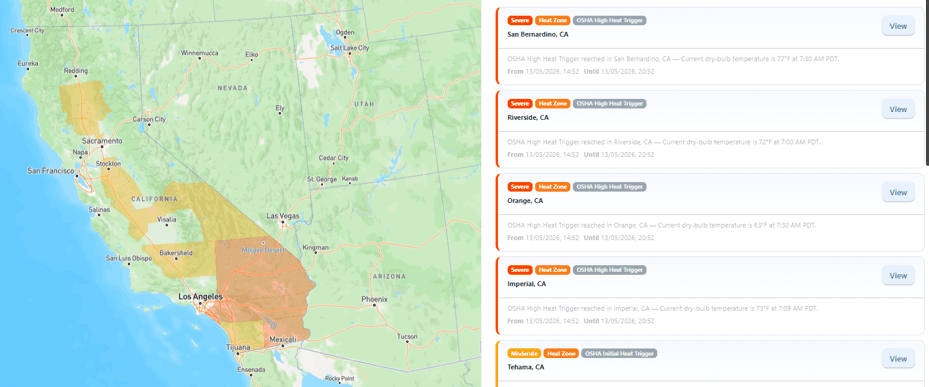
How Alert Zone Intelligence works
When a worker approaches or enters one of those zones, they get a proximity or in-zone push notification with the relevant safety guidance, before anything has escalated into a missed check-in or an emergency. Monitors see the same zones overlaid on the worker-location map, and every notification is logged turning what would otherwise be an invisible, informal "heads up, be careful out there" into a documented, auditable safety activity.
That's a meaningfully different kind of data than a missed check-in count. It's a record of hazard awareness delivered proactively, which is precisely the category OSHA is describing when it talks about activities that "reveal potential problems" ahead of an incident, rather than counting the incident afterward.
What this means for leadership
Real-time risk intelligence doesn't replace the reactive layer, and OSHA's own framing is clear that it shouldn't try to - lagging indicators still measure whether the program is actually working. What it does is give industrial EHS leaders something to point to between the incident reports: evidence that workers were warned about a real, verified hazard in their path, and a timestamped record of when and how. For programs under pressure to show they're improving safety rather than just documenting it after the fact, that's the practical difference between reactive and predictive - and it's the case OSHA itself has already made.
*OK Alone's Alert Zone Intelligence is available across the platform for iOS and Android. To see how real-time risk intelligence fits alongside your existing check-in and escalation protocols, visit [okaloneworker.com].
Key Takeaways
- Lagging indicators measure incidents that have already happened, while leading indicators focus on proactive and preventive safety activity.
- Strong safety programs use both: leading indicators to support prevention and lagging indicators to measure effectiveness.
- For lone and mobile workers, real-time, location-based risk intelligence can provide earlier warning of severe weather, heat risks, verified incidents, and known hazards.
- Location-based alerts can turn informal hazard awareness into documented, timestamped safety activity.
- Predictive safety technology complements rather than replaces check-ins, SOS alerts, escalation procedures, and emergency response.
- Moving from reactive to predictive safety gives EHS leaders greater visibility into the steps being taken to prevent incidents, not just the incidents that have already occurred.
Frequently Asked Questions
Lagging indicators measure events that have already occurred, such as injuries, illnesses, and fatalities. Leading indicators are proactive and preventive measures that can help reveal potential safety problems before they result in an incident.
Real-time risk intelligence gives workers and safety teams timely information about hazards near a worker's location. This can include severe weather, heat risks, verified incidents, and organization-specific hazard zones.
No. Leading and lagging indicators serve different purposes. Leading indicators help organizations improve prevention, while incident reporting and other lagging indicators help measure whether the overall safety program is effective.
Alert Zone Intelligence can send workers proximity or in-zone notifications when they approach identified hazards. Monitors can see the same zones on the worker-location map, and notifications are logged to create a record of proactive safety activity.
Leading indicators give EHS leaders visibility into preventive safety activities taking place before an incident occurs. Combined with lagging indicators, they provide a more complete picture of safety performance.
Sources:



Stacey Manclark
As an expert in lone worker content management, I possess an extensive knowledge base and experience in the area of lone working and safety monitoring. My expertise in this field encompasses a wide range of areas, including risk assessment, training, communication, and technology. I have a deep understanding of the unique risks associated with lone workers and have researched and written many projects and articles to educate people in how to mitigate these risks.
Throughout my time with OK Alone, I have kept up to date with technological developments, legislative changes and regulations that have been introduced to help organizations ensure the safety of their lone workers.
Book a Demo Today
Alternatively, get a free trial of the app
Want to try OK Alone? Click the button below and enter your details. It's free and no credit card is required.
