What Good Lone Worker Compliance Looks Like in 2026

Ask ten companies whether they're compliant with lone worker legislation and you'll probably receive ten confident "yes" answers.
Now ask those same companies how they would respond if a worker missed a check-in at 8:30pm on a Friday evening. Who receives the alert? How quickly is it escalated? What evidence could they produce following a serious incident? Suddenly, the answers often become far less certain.
That's because compliance has changed.
Modern lone worker safety is no longer judged solely on whether a policy exists or a risk assessment has been completed. Increasingly, regulators, clients and insurers want to see that safety procedures work in practice. The strongest organizations have recognized this shift. Rather than treating compliance as a one-time exercise, they've built practical safety programs that form part of their day-to-day operations.
So, what does good lone worker compliance actually look like in 2026?
Understanding Who Your Lone Workers Really Are
Many businesses underestimate how many people actually work alone.
When asked, managers often think only of obvious field-based roles. In reality, lone working occurs across almost every industry. Healthcare professionals visit patients, housing officers meet tenants, engineers and maintenance technicians work across multiple sites, while property inspectors, drivers, retail staff opening or closing premises, security personnel, utility crews, environmental officers and managers traveling between offices may all spend significant periods working without immediate support.
Even employees working from home may occasionally find themselves isolated during working hours. Good compliance begins by identifying every role where assistance may not be immediately available if something goes wrong.
The question isn't simply:
Who works alone?
It's:
Who could reasonably find themselves without immediate help while carrying out their work?
Good Risk Assessments Go Beyond Physical Hazards
Traditionally, lone worker risk assessments focused on slips, trips, falls and manual handling. While these hazards remain important, modern risk assessments need to consider a much wider range of factors.
For example:
- workplace violence
- aggression from members of the public
- medical emergencies
- fatigue
- extreme weather
- heat exposure
- remote locations
- poor mobile coverage
- vehicle breakdowns
- mental well-being
- working outside normal hours
Every role presents a different combination of risks. A social worker may require different safeguards from a utilities engineer, while a home healthcare worker faces different challenges to a retail employee closing a store late at night.
Good leadership teams recognize that a single generic lone worker risk assessment rarely reflects operational reality.
Policies Need to Be Practical
One of the biggest weaknesses in many lone worker programs isn't the policy itself, but whether people can realistically follow it. A well-written document achieves very little if workers find it difficult to apply during a busy working day.
Effective organizations keep their procedures simple, ensuring workers understand:
- when they should start a lone working session
- when they should check in
- what situations require additional precautions
- how to raise an emergency alarm
- what happens after an alert is triggered
Managers also understand exactly what their responsibilities are, leaving very little room for ambiguity. If an incident occurs, everyone already knows what happens next.
Check-Ins Should Match the Level of Risk
Not every lone worker requires the same level of monitoring. That's one of the fundamental principles of proportionate risk management.
Someone working from home carrying out administrative tasks may only require basic arrangements, while someone entering client homes, working in remote locations or undertaking high-risk activities may require significantly more frequent welfare checks.
Good employers tailor their approach according to risk rather than applying identical procedures to every employee. Typical considerations include:
- the nature of the work
- location
- time of day
- previous incidents
- communication reliability
- environmental conditions
- public interaction
The objective isn't to create unnecessary administration, but to ensure workers can obtain assistance quickly if circumstances change.
Escalation Procedures Should Never Depend on One Person
Imagine a worker misses a scheduled check-in. What happens next?
Many companies rely on a single supervisor noticing the issue and taking action. That approach works—until the supervisor is unavailable. Robust safety programs avoid single points of failure by establishing clear escalation procedures. If the first contact cannot be reached, responsibility automatically passes to someone else. For higher-risk operations, organizations often define multiple levels of escalation, ensuring there is always another route available if the initial response fails.
Everyone involved understands:
- who receives alerts
- how quickly they should respond
- what information they need
- when emergency services should be contacted
- how the incident should be documented afterwards
Clear escalation procedures remove uncertainty in situations where every minute matters.

Workers and Managers Both Need Training
Training is often overlooked because managers often assume safety procedures are self-explanatory. In reality, effective programs rely on everyone understanding their role.
Workers need confidence that they know:
- how to use safety procedures
- when additional precautions are appropriate
- how to request assistance
- what information responders will receive
Managers require different training. They need to understand:
- how alerts are managed
- escalation responsibilities
- documentation requirements
- privacy obligations
- post-incident reviews
Good compliance isn't created by technology. It's created by people who understand how the system works.
Records Matter More Than Ever
Following a serious incident, organizations may need to demonstrate the steps they took to protect their employees. That means keeping accurate records.
Examples include:
- risk assessments
- training records
- lone worker procedures
- welfare checks
- incident reports
- investigation findings
- corrective actions
- review meetings
These records serve two important purposes. First, they demonstrate compliance where required. Second, they provide valuable insight that helps organizations continually improve their safety programs.
The strongest organizations don't collect information simply because regulations require it. They use it to identify trends, recurring risks and opportunities to strengthen worker protection.
Privacy Should Be Built Into Every Programme
One concern frequently raised whenever organizations introduce lone worker technology is privacy. Employees understandably want reassurance that safety measures won't become performance monitoring.
Leading organizations address this openly, ensuring workers understand:
- when location information is visible
- who can access it
- why it's collected
- how long it's retained
- when it will be deleted
Transparency builds trust. When employees understand that monitoring exists solely to protect them during working hours or higher-risk activities, participation and engagement are typically much higher.

Technology Supports Compliance—It Doesn't Define It
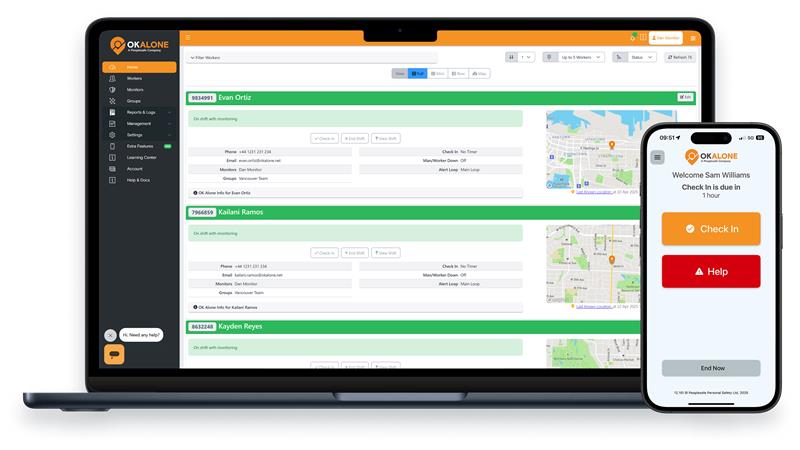
Technology now plays an important role in many lone worker programs. Mobile safety applications, automated welfare checks, emergency alerts, location sharing during active work, satellite communication and 24-hour monitoring can all significantly strengthen worker protection.
However, technology should always support an already well-designed operating model.
Without clear procedures, even the most advanced safety platform cannot answer important operational questions:
- Who responds first?
- What happens if nobody answers?
- Who contacts emergency services?
- How are incidents reviewed afterwards?
Good compliance is created by combining people, procedures and technology into one coherent system.
Questions Every Leadership Team Should Be Asking
- One of the simplest ways to assess your current approach is to ask a series of practical questions. Whether a company employs twenty people or twenty thousand, leadership teams should regularly challenge themselves by asking:
- Do we know exactly which roles involve lone or isolated working?
- Have we reviewed those risks recently?
- Are our procedures proportionate to the level of risk?
- Have we considered violence, environmental hazards and well-being alongside physical safety?
- Would our escalation procedures still work outside office hours?
- Have workers been involved in shaping our procedures?
- Could we demonstrate our actions following a regulator's investigation or serious incident?
- Are we reviewing incidents and near misses to improve our programme?
These conversations often reveal opportunities for improvement long before they become compliance issues.
Looking Beyond Minimum Compliance
Perhaps the biggest difference between average organizations and leading organizations is their mindset.
Average organizations ask:
"What do we need to do to comply?"
Leading organizations ask:
"What do we need to do to keep our people safe?"
When companies focus on protecting people, compliance naturally follows.
This approach also creates more resilient teams. As legislation evolves across North America and internationally, businesses that already operate mature lone worker programs are usually well positioned to adapt because the fundamental building blocks are already in place.
Final Thoughts
Good lone worker compliance in 2026 isn't defined by paperwork. It's defined by preparation.
It's about understanding where risks exist, training workers and managers, creating practical procedures, testing those procedures, keeping accurate records, learning from incidents and regularly reviewing programs as working practices evolve. Most importantly, it's recognizing that protecting lone workers is an ongoing operational responsibility rather than an annual compliance exercise.
Organizations that adopt this mindset won't simply be better prepared for future legislation. They'll create safer workplaces, respond more effectively when incidents occur, and demonstrate that duty of care is something they put into practice every day.
Frequently Asked Questions
Good lone worker compliance combines risk assessment, practical procedures, appropriate monitoring, clear escalation processes, training and accurate record-keeping. It should form part of everyday operations rather than being treated as a one-time exercise.
A lone worker is anyone who may carry out work without immediate access to help. This can include field-based employees, drivers, healthcare workers, maintenance teams, retail staff, security personnel and employees working remotely or outside normal hours.
A lone worker risk assessment should consider the specific risks associated with the role, including physical hazards, workplace violence, medical emergencies, remote locations, poor mobile coverage, extreme weather, fatigue and working outside normal hours.
Lone worker procedures should be reviewed regularly as working practices and risks change. Incidents, near misses and changes to roles or working environments can also highlight areas that need to be updated.
No. Monitoring should be proportionate to the level of risk. Lower-risk roles may require basic arrangements, while employees working in remote locations, entering client homes or carrying out higher-risk activities may need more frequent welfare checks.
There should be a clear escalation procedure that defines who receives the alert, how quickly they should respond, what happens if the first contact is unavailable and when emergency services should be contacted.
No. Technology can support a strong lone worker safety programme, but it does not replace good procedures. Effective protection combines people, processes and appropriate technology into one clear system.
Useful records include risk assessments, training records, lone worker procedures, welfare checks, incident reports, investigation findings, corrective actions and review meetings. These records can help demonstrate what measures were in place and identify opportunities to improve worker safety.





Stacey Manclark
As an expert in lone worker content management, I possess an extensive knowledge base and experience in the area of lone working and safety monitoring. My expertise in this field encompasses a wide range of areas, including risk assessment, training, communication, and technology. I have a deep understanding of the unique risks associated with lone workers and have researched and written many projects and articles to educate people in how to mitigate these risks.
Throughout my time with OK Alone, I have kept up to date with technological developments, legislative changes and regulations that have been introduced to help organizations ensure the safety of their lone workers.
Book a Demo Today
Alternatively, get a free trial of the app
Want to try OK Alone? Click the button below and enter your details. It's free and no credit card is required.
