15 Best Personal Safety Alarms for Elderly Workers and Employees in 2026
Personal safety alarms for elderly workers are becoming an increasingly important consideration as workforces change. In many industries, experienced employees are continuing to work later into their careers, often in roles that still involve independent or field-based work.
For employers, this introduces a slightly different set of considerations. It is not simply about age, but about understanding whether health-related risks, combined with working alone, could increase the likelihood of an incident going unnoticed.
Personal safety alarms are often the first solution considered in these situations. However, selecting the right approach requires a bit more thought than choosing a device. It involves understanding the type of risk involved and how that risk is most effectively monitored. When considering personal safety alarms for elderly workers in 2026, organisations need to assess how well different approaches support both health-related risks and lone working conditions.
Key Takeaways
- Age alone does not determine whether a worker needs additional safety protection. Employers should assess individual roles, working conditions and foreseeable risks.
- Wearable personal alarms provide a way to request emergency assistance, while devices with automatic detection may offer additional protection against certain incidents.
- Hardware-based alarm systems require ongoing device management, including charging, maintenance and replacement.
- Structured lone worker monitoring uses scheduled check-ins and automatic escalation to help identify when someone may need assistance.
- Smartphone-based systems can offer a practical alternative where isolation and delayed awareness are greater concerns than sudden incapacitation.
- Safety arrangements should respect worker independence, privacy and dignity without making assumptions based on age.
- The most appropriate safety solution depends on a documented risk assessment rather than the worker's age or the number of features available.

Understanding the Risk Profile of Ageing Workers
It is important not to assume that age alone creates risk, but rather to consider how lone worker protection for ageing employees should be applied in context. Many older employees carry out their roles without any additional exposure. That said, certain working patterns can increase the impact of an incident if one does occur. Working alone in remote areas, travelling between locations or operating outside normal hours can all contribute to delayed awareness.
In these situations, the key issue is not just whether an incident happens, but how quickly it is recognised and responded to.
That is where the choice of monitoring method becomes important.

Types of Personal Safety Alarms
There are several types of systems commonly used to support lone workers.
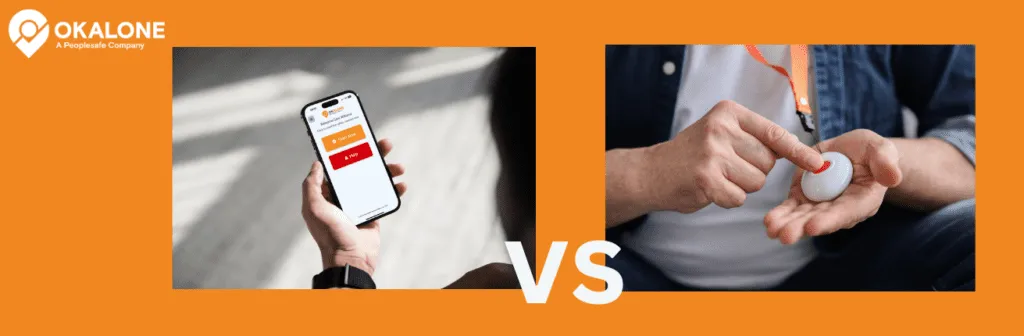
Some organisations use wearable panic buttons or workplace medical alert systems, such as medical alert pendants, which allow a worker to raise an alarm if they feel unwell or unsafe. Others use app-based systems that operate through smartphones and focus on regular safety confirmation.
Devices can be useful where there is a clear possibility of sudden incapacitation, particularly if they include fall detection. However, they are still largely reactive. They rely either on the worker pressing a button or on a sensor detecting a specific event.
That distinction matters more than it might first appear.
Comparing Personal Safety Alarm and Monitoring Options
Different safety approaches offer different levels of protection. The most appropriate option depends on the risks associated with the worker's role and working environment.
| Safety Approach | Best Suited To | Main Benefit | Key Consideration |
|---|---|---|---|
| Wearable panic alarm | Workers who may need to request immediate assistance. | Allows the worker to activate an emergency alert. | Requires the worker to recognize the danger and activate the device. |
| Medical alert device with automatic detection | Workers with identified risks of falls or physical incapacitation. | May detect certain incidents without manual activation. | Detection capabilities vary, and devices require charging and maintenance. |
| Smartphone-based structured monitoring | Lone and mobile workers where isolation or delayed awareness is the main concern. | Scheduled check-ins and automatic escalation help identify missed safety confirmations. | Check-in intervals and response procedures must match the assessed risks. |
| Combined emergency alerts and structured monitoring | Workers who benefit from both manual emergency activation and regular safety checks. | Provides different ways to raise concerns or identify missed check-ins. | Both monitoring and emergency response procedures need to be established and tested. |

The Limitations of Hardware-Only Models
While wearable devices can provide reassurance, they also introduce practical and operational challenges.
Devices need to be issued, charged, maintained and replaced. As teams grow or change, managing that process can become increasingly time-consuming. There is also the question of what happens if the device is not used, not worn, or simply not activated.
More importantly, hardware-based systems tend to focus on the moment of the incident. They do not always provide ongoing oversight if nothing is triggered.
This is where structured lone worker monitoring offers a different approach. Instead of waiting for an alarm, systems like OK Alone build regular safety confirmation into the working day. If a worker does not check in as expected, the system responds automatically.
For many organisations, particularly where isolation is the main concern, this provides a more consistent level of oversight.

When Medical Alert Devices Are Appropriate
There are situations where dedicated devices are clearly the right choice.
If there is a known risk of medical events, or if the role involves physical strain or environments where falls are more likely, then automatic detection can add an important layer of protection.
In these cases, the ability to trigger an alert without relying on manual input can make a real difference.
The key is that the decision is based on credible risk, not assumption.

When Structured Monitoring May Be More Appropriate
In many roles, the risk profile looks quite different.
Workers may be operating independently, but not in physically hazardous environments. The concern is less about sudden collapse and more about the possibility that something could go unnoticed for too long.
Structured monitoring is designed to address exactly that. By asking workers to confirm their safety at intervals, and by responding when that confirmation is missed, it creates a simple but reliable way to maintain oversight.
OK Alone applies this approach through an employee safety monitoring app, without requiring additional equipment. It gives staff access to both a panic button and structured monitoring, making it easier to deploy across teams and maintain over time.

Balancing Safety and Dignity
There is also a human aspect to consider.
Introducing highly visible medical devices into the workplace can sometimes feel unnecessary or even intrusive, particularly if the level of risk does not justify it.
A more balanced approach allows workers to maintain their independence while still providing reassurance that support is there if needed. Structured monitoring achieves this by focusing on confirmation rather than constant observation.

Scalability Across Age-Diverse Teams
Most organisations are managing mixed teams, not just older employees.
Applying different systems to different groups can create inconsistency and make processes harder to manage. A single approach that works across the entire workforce is often more practical.
Because OK Alone operates through smartphones, it can be used consistently across teams, regardless of age or role, without introducing additional layers of administration, making it a scalable worker safety solution across mixed teams.

Conclusion
Personal safety alarms can play an important role, but they are not always the most appropriate solution.
The decision should always come back to the type of risk involved. Where there is a clear likelihood of medical events, devices may be justified. Where isolation and delayed awareness are the main concerns, structured monitoring often provides a more practical and scalable approach.
OK Alone is designed around the principle of giving people both options. Its panic button and structured monitoring provide a way to support lone workers without adding unnecessary complexity.
Frequently Asked Questions
Not automatically. Protection should align with documented risk assessment findings.
Only where credible health-related incapacitation risk exists.
Yes. Structured check-ins and automated escalation provide oversight without hardware.
Only where fall risk is credible within the role.
No. It operates entirely via smartphones.
No. It focuses on scheduled confirmation rather than constant surveillance.
In many roles where isolation is the primary exposure, yes.
Yes. It can be deployed across all lone workers regardless of age.
Yes. It provides documented check-ins and escalation logs.
Begin with the Lone Worker Risk Assessment Guide to evaluate exposure before selecting technology.



Stacey Manclark
As an expert in lone worker content management, I possess an extensive knowledge base and experience in the area of lone working and safety monitoring. My expertise in this field encompasses a wide range of areas, including risk assessment, training, communication, and technology. I have a deep understanding of the unique risks associated with lone workers and have researched and written many projects and articles to educate people in how to mitigate these risks.
Throughout my time with OK Alone, I have kept up to date with technological developments, legislative changes and regulations that have been introduced to help organizations ensure the safety of their lone workers.
Book a Demo Today
Alternatively, get a free trial of the app
Want to try OK Alone? Click the button below and enter your details. It's free and no credit card is required.
