Field Service Management Software for Lone Worker Safety in 2026

Field service management software has become essential for organisations managing increasingly distributed operations. Technicians often work across multiple locations, moving between sites and operating independently for much of the day. While these platforms help with scheduling, job allocation and reporting, they were not designed with worker safety as their primary focus.
When workers are operating alone, an additional layer of monitoring is needed to ensure that their wellbeing is actively managed. As field service management software evolves in 2026, organisations are placing greater emphasis on how these systems support both operations and worker safety.

What Field Service Management Software Does — and Doesn’t Do
Field service management systems are built to support operational efficiency, but they are not designed as lone worker field safety software. They provide visibility over jobs, track progress and help organisations manage resources effectively. This is essential for keeping work on schedule and maintaining service quality.
What they do not do is confirm that a worker is safe.
A technician can continue working, complete tasks and update systems while still experiencing a problem that goes unnoticed. Without a structured way to check on their wellbeing, there is a risk that incidents are only identified after the fact.

The Safety Gap in Field Operations
In many field service roles, the main risk is not heavy industrial hazard, but isolation.
Technicians regularly enter unfamiliar environments, travel between locations and work without immediate support. They may interact with the public or operate outside normal hours, all of which adds a level of unpredictability. This is where field technician safety monitoring becomes essential.
The challenge is not just managing the work, but ensuring that someone will notice if something goes wrong.
Structured monitoring addresses this by turning a lack of response into a trigger for action.


Integrating Structured Monitoring with Field Operations
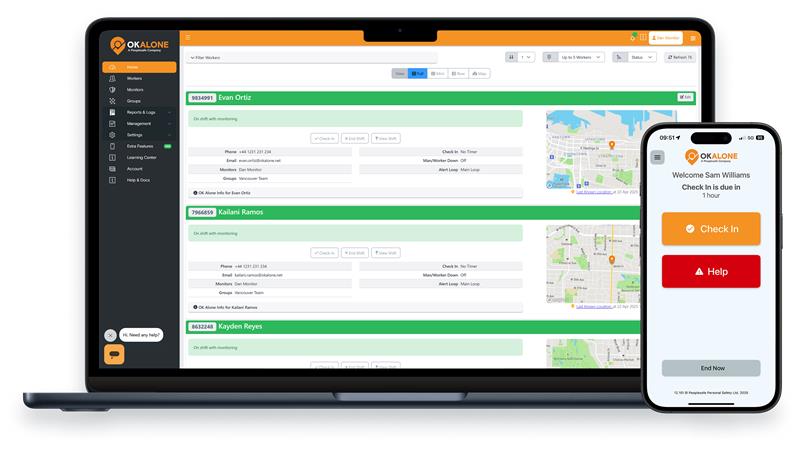
OK Alone is designed as an app-based field monitoring solution that sits alongside existing field service systems rather than replace them.
While operational platforms manage jobs and workflows, OK Alone focuses on safety. Workers check in at intervals during their shift, and if that confirmation is not received, escalation begins automatically.
This creates a clear separation between operational management and safety monitoring, while ensuring that both are covered.
Scalability Across Field Teams
Field service organisations often deal with changing team sizes. Contractors may be brought in for specific projects, or demand may increase at certain times of year.
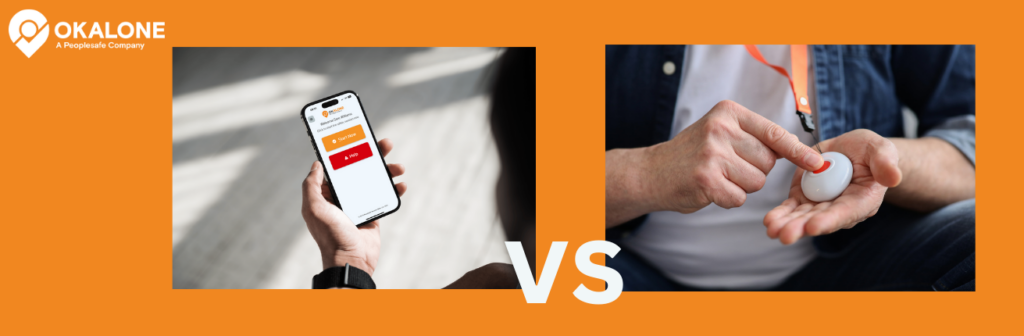
Systems that rely on hardware can struggle to keep up with this kind of flexibility. Devices need to be issued, returned and managed, which adds to costs and the workload.
OK Alone avoids this by using smartphones. New workers can be added quickly, making it easier to scale without introducing additional processes, particularly for organisations looking for a scalable lone worker solution.

Compliance and Audit Readiness
There is increasing pressure on organisations to demonstrate that they are managing lone worker risk effectively.
Structured monitoring provides a clear record of activity. Check-ins, escalation steps and response times are all recorded automatically, creating an audit trail that supports compliance.
This makes it easier to show that appropriate steps have been taken to monitor and protect workers.

When Hardware May Be Necessary
There are still situations where additional measures are needed.
In higher-risk environments, such as utilities or heavy engineering, the possibility of injury may justify the use of devices with automatic detection capabilities, such as gas exposure monitoring.
However, in many field service roles, the main concern is isolation rather than physical hazard.

Operational Simplicity in 2026
As systems become more advanced, there is also a growing need to keep things simple.
Organisations are looking for solutions that can be deployed quickly, used consistently and managed without adding unnecessary overhead.
OK Alone is designed with this in mind, providing a straightforward way to introduce structured monitoring without adding extra layers of complexity.

Conclusion
Field service management software is essential for running operations, but it does not replace the need for safety monitoring.
By adding structured check-ins and automated escalation, OK Alone provides a practical way to ensure that lone workers are supported throughout the day, without disrupting existing systems.

Frequently Asked Questions
1. Does FSM software include safety monitoring?
Not usually. It focuses on operations rather than safety.
2. How does OK Alone support field technicians?
Through scheduled check-ins and automated escalation.
3. Is hardware required?
Not always. Structured monitoring may be sufficient.
4. Can OK Alone work with FSM systems?
Yes. It runs alongside them.
5. Is it scalable?
Yes. It supports distributed teams.
6. Does it support contractors?
Yes. It is suitable for flexible workforces.
7. Is structured monitoring compliant?
Yes, when aligned with risk assessment.
8. When is fall detection required?
In higher-risk environments.
9. Does it require device management?
No. It uses smartphones.
10. How should organisations assess safety needs?
Through a risk-based approach.



Stacey Manclark
As an expert in lone worker content management, I possess an extensive knowledge base and experience in the area of lone working and safety monitoring. My expertise in this field encompasses a wide range of areas, including risk assessment, training, communication, and technology. I have a deep understanding of the unique risks associated with lone workers and have researched and written many projects and articles to educate people in how to mitigate these risks.
Throughout my time with OK Alone, I have kept up to date with technological developments, legislative changes and regulations that have been introduced to help organizations ensure the safety of their lone workers.
Book a Demo Today
Alternatively, get a free trial of the app
Want to try OK Alone? Click the button below and enter your details. It's free and no credit card is required.
