Are Personal Emergency Alarms Effective? Complete Safety Guide 2026

Personal emergency alarms are often seen as the default solution for lone worker safety. Whether worn as a pendant, clipped to clothing or built into a device, they are designed to give workers a way to call for help when something goes wrong.
Key Takeaways
- Personal emergency alarms are most effective when they match the specific risks workers face.
- Manual SOS alarms depend on the worker being able to recognize the danger and activate the alarm.
- Automatic detection can provide additional protection where falls, collapse, or incapacitation are credible risks.
- An emergency alarm is only one part of a wider safety process. Monitoring, escalation, and response procedures are equally important.
- Employers should select safety technology based on a documented risk assessment rather than choosing features in isolation.
- For many lone workers, combining emergency activation with scheduled check-ins and automated escalation can provide broader protection.
- Training, regular testing, worker adoption, and a reliable response process are essential to making any personal safety system effective.
At first glance, that seems straightforward. If there is an emergency, the worker activates the alarm and assistance follows.
However, in practice, the effectiveness of these systems depends on more than just having them in place. The real question organisations need to ask is whether the alarm will actually be triggered when it matters.
That depends entirely on the type of risk workers are exposed to and how reliably incidents can be detected.
This raises an important question for organisations in 2026: are personal emergency alarms effective for lone worker safety in real-world conditions?

What Personal Emergency Alarms Are Designed to Do
Personal emergency alarms are designed to respond to situations where a worker is aware of a problem and able to act.
If someone feels threatened, becomes unwell but remains conscious, or needs immediate assistance, a panic alarm provides a direct way to raise that alert. In these situations, the system can be very effective, particularly when escalation procedures are clearly defined and response is prompt.
Some devices also include fall detection, which removes some reliance on manual activation. Even so, these systems are still centred around a specific moment — either the worker pressing a button or a sensor detecting an event.
That is an important limitation to understand.

The Core Limitation of Workplace Panic Alarm Effectiveness
The effectiveness of any panic alarm ultimately comes down to whether it is activated.
If a worker becomes unconscious, disoriented, unable to reach the device or simply does not recognise the need to raise the alarm early enough, the system does not engage. In those situations, the presence of the device does not translate into protection.
This is not an uncommon scenario.In many lone worker incidents, the issue is not the absence of an alarm, but the delay in recognising that something has gone wrong.
When that happens, relying solely on activation introduces a single point of failure.
Structured Monitoring as a Detection Alternative
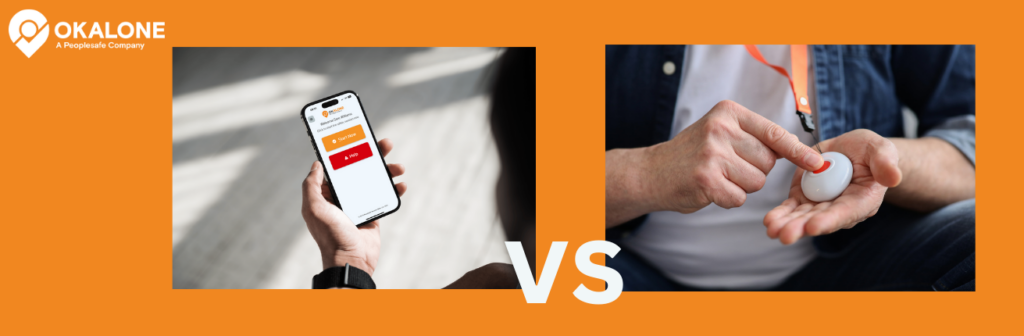
As an alternative to traditional alarms, structured safety monitoring approaches the problem from a different angle. Instead of waiting for an alarm to be triggered, it builds regular safety confirmation into the working day. Workers check in at agreed intervals, and if that confirmation is not received, the system responds automatically.
This changes the role of monitoring entirely. A lack of response becomes a signal in itself, rather than something that goes unnoticed.
OK Alone is designed around this principle. By combining scheduled check-ins with automated escalation, it ensures that potential issues are identified even when a worker is unable to raise the alarm themselves.

When Personal Emergency Alarms Are Effective
Emergency alarms still have a clear role in many environments.
Where workers are exposed to situations that may require immediate manual escalation — such as confrontation, lone visits in higher-risk settings or physically demanding tasks — the ability to trigger an alert directly can be important.
They are most effective when the worker is able to recognise the risk and respond in the moment.

When Alarms Alone May Be Insufficient
In other roles, where different lone worker protection methods are needed, the risk profile looks different. Workers may be spread across locations, operating independently for long periods, with limited direct contact. In these situations, the greater risk is often that something happens, and no one notices quickly enough.
This is where alarm-only systems can fall short. Without a trigger, there is no response.
Structured monitoring fills that gap by ensuring that silence is recognised and acted upon. Rather than replacing alarms entirely, it provides a more consistent layer of oversight, particularly in isolation-driven roles.

Scalability and Administrative Considerations
There is also a practical side to consider.
Hardware-based alarm systems require ongoing management. Devices need to be distributed, maintained, charged and replaced over time. As organisations grow, this can become a significant administrative task.
App-based systems remove much of that complexity. OK Alone operates through smartphones, allowing new users to be added quickly without additional equipment. This makes it easier to scale across teams and locations as a scalable lone worker solution.

Compliance and Proportionality
From a compliance perspective, the focus is not on choosing a specific type of device, but on ensuring that the controls in place are appropriate for the risks involved.
If activation-based alarms match the level of risk, they may be entirely suitable. If the primary concern is delayed awareness, then a more proactive approach may be needed.
What matters is that the chosen system can be justified as a proportionate response to the actual working environment.

Conclusion
Personal emergency alarms can be effective, but only within the limits of how they are used.
Where activation is reliable and appropriate to the situation, they provide a valuable tool. Where incidents may go unnoticed or workers may be unable to respond, relying on alarms alone can leave gaps.
In those cases, structured monitoring systems provide a more proactive approach, ensuring that a lack of response is recognised and acted on without delay. OK Alone is designed around the principle of giving people both options, offering a way to support lone workers without adding unnecessary complexity.
Frequently Asked Questions
They can be effective when activated, but reliability depends on user activation or sensor detection.
Only if fall detection is included and functions correctly.
In many isolation-driven roles, yes.
OK Alone focuses on structured check-ins and automated escalation rather than dedicated hardware alarms.
No specific device is mandated. Controls must align with risk exposure.
Dependence on activation.
Yes. Missed check-ins trigger escalation automatically.
No. It operates via smartphones.
App-based systems typically scale more easily.
Start with the Lone Worker Risk Assessment Guide and assess detection needs before selecting technology.




Stacey Manclark
As an expert in lone worker content management, I possess an extensive knowledge base and experience in the area of lone working and safety monitoring. My expertise in this field encompasses a wide range of areas, including risk assessment, training, communication, and technology. I have a deep understanding of the unique risks associated with lone workers and have researched and written many projects and articles to educate people in how to mitigate these risks.
Throughout my time with OK Alone, I have kept up to date with technological developments, legislative changes and regulations that have been introduced to help organizations ensure the safety of their lone workers.
Book a Demo Today
Alternatively, get a free trial of the app
Want to try OK Alone? Click the button below and enter your details. It's free and no credit card is required.
